
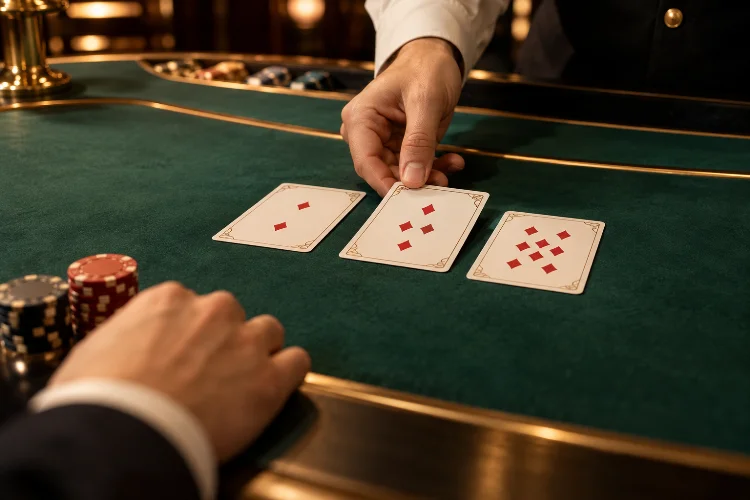
Red Dog is one of those casino games that looks unfamiliar until you see one round. Then the entire idea becomes surprisingly simple. Two cards are shown, and you are essentially betting on whether a third card will land between them in rank.
This Red Dog Casino Game Explained guide walks through the rules without burying the game under complicated poker terminology.
You will learn what a spread means, when a round becomes a push, how payouts change, and why players sometimes get the option to increase their original wager before the final card appears.
What Is the Red Dog Casino Game?
Red Dog is a casino card game also associated with names such as In Between and Acey-Deucey. In the casino version, the objective is straightforward: the third card must rank strictly between the first two cards for the main wager to win.
Cards are ranked from 2 through Ace, with Ace high. Suits do not matter, so a heart has no advantage over a spade or club.
Different versions may use different numbers of decks. BCLC’s published rules, for example, specify four to six standard decks, while some online implementations use a single deck.
That means the core gameplay is very stable even though the exact mathematical edge can vary slightly between versions.
How a Typical Round Begins
The round starts when the player places an initial wager.
The dealer then turns over two cards. These cards create the basic situation for the hand.
If the cards are neither identical nor consecutive, the dealer calculates the spread. The spread is simply the number of card ranks sitting between those first two cards.
Imagine the opening cards are 4 and 9.
The possible ranks between them are 5, 6, 7, and 8, so the spread is four.
At this point, the player may normally continue with the original wager or add a raise equal to the original stake, depending on the table rules. BCLC rules allow a raise equal to the original wager when the opening cards are neither consecutive nor a pair.
Understanding the Spread
The spread is the most important concept in Red Dog because it determines both the chance of winning and the payout.
A narrow spread is difficult to hit, so it pays more. A wide spread is easier to hit, but the payout becomes smaller.
The standard payout schedule is:
| Spread | Winning Payout |
|---|---|
| 1 | 5 to 1 |
| 2 | 4 to 1 |
| 3 | 2 to 1 |
| 4–11 | 1 to 1 |
These payouts appear in both BCLC’s published rules and commonly documented casino versions of Red Dog.
Suppose the first cards are 7 and 9. Only an 8 sits between them, giving a spread of one. Hitting that single available rank is difficult, so a successful wager pays 5:1.
With a 2 and Ace, there are eleven ranks in between. The third card has many more ways to land inside the spread, but a win pays only even money.
What Happens With Consecutive Cards?
Sometimes the first two cards leave no space at all.
If they are 8 and 9, for example, no rank exists between them.
The standard rule is a push. The wager is returned and no third card needs to be drawn. BCLC’s rules explicitly classify consecutive opening cards as a tie.
This is easy to confuse with losing.
A push means neither the player nor the house wins the main wager. You simply move on to the next round.
The same principle applies to A-K because Ace is treated as high, making King and Ace consecutive ranks in the normal casino format.
What Happens When the First Two Cards Match?
Pairs create a completely different situation.
Suppose the dealer reveals two queens.
There is obviously no normal spread between identical ranks. Instead, a third card is immediately dealt.
If that third card is also a queen, the hand becomes three of a kind and traditionally pays 11:1. If it is anything else, the hand pushes.
The player does not normally get to raise when the first two cards are a pair.
This rare 11:1 event adds a little drama to what is otherwise a very simple game. It can also confuse beginners who assume a pair automatically means the round has already ended.
It has not—the third card decides whether you receive the large payout or simply get the wager back.
How the Raise Option Works
When a genuine spread appears, many versions give the player one meaningful decision: whether to increase the bet.
In a traditional table game, the raise can usually equal the original wager.
Suppose you initially bet $10 and see a wide spread. If you raise another $10, your total amount at risk becomes $20.
The same spread payout then applies to the combined bet if the third card lands inside the gap. Online versions can label the alternatives as “Call” and “Raise,” but the basic idea is the same.
This is where the only significant strategy enters the game.
You are not choosing cards, drawing selectively, or competing against another player’s hand. You are deciding whether the current spread is attractive enough to justify exposing additional money.
A Complete Red Dog Example
Imagine you place a $10 wager.
The dealer reveals a 3 and a 10.
The ranks between them are 4, 5, 6, 7, 8, and 9, so the spread is six.
You decide not to raise.
The third card is an 8. Because 8 falls strictly between 3 and 10, the wager wins. A spread of six falls into the “4 or more” category, so the payout is even money.
If the third card had been a 3, 10, Jack, Queen, King, Ace, or 2, the bet would lose because the result is either equal to an outside boundary or completely outside the spread.
This strict “between” rule is the key detail beginners sometimes forget.
Landing exactly on one of the original card ranks does not count as a win.
Does Red Dog Have a House Edge?
Yes.
The exact mathematical advantage depends partly on the number of decks and how the player handles the raise decision.
Wizard of Odds calculates a house edge of about 3.155% for a one-deck game, 2.798% for six decks, and 2.751% for eight decks when the documented optimal raising strategy is used.
Interestingly, additional decks slightly reduce the house edge in this game.
That is different from what some players may be familar with from blackjack.
The percentages also describe long-run mathematical expectation, not what must happen in one short session. A player can win or lose substantially more than the theoretical edge over a small number of rounds.
Why Red Dog Is Easy to Learn but Still Random
There are no poker combinations to memorise.
You do not need to decide whether to hit, stand, split, or discard cards. Most rounds come down to looking at the spread and waiting for the third card.
That simplicity can make the game feel very controllable.
In reality, the card outcome remains random. The player can make a better or worse raising decision, but cannot control which third card appears.
This distinction is important because a few winning rounds do not reveal a reliable future pattern. Likewise, a losing sequence does not make the next hand “due” to win.
The strategic part is small; the chance element is large.
This Red Dog Casino Game Explained overview comes down to one simple challenge: the third card must fall between the first two.
Narrow spreads offer larger payouts, wide spreads are easier to hit, consecutive cards push, and matching opening cards create a special three-of-a-kind opportunity.
Before playing, check the exact deck count and payout table, then understand the raise rules so you know exactly how much is at risk.