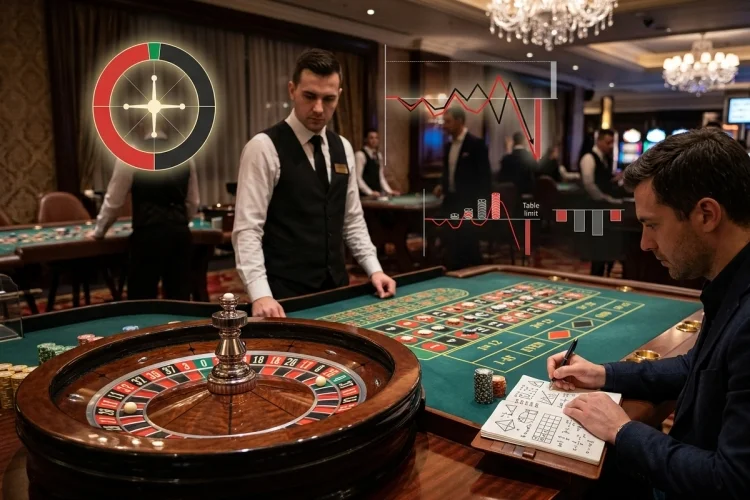

Casino odds can look mysterious when all you see is a roulette wheel, two dice, or cards landing on a table. Behind every wager, however, there is usually a mathematical relationship between the chance of winning and the amount the game pays.
Understanding How Casino Odds Are Calculated does not require advanced mathematics. The main ideas are probability, payout ratios, expected value, and house edge.
Once you understand how those pieces fit together, numbers such as 35:1, 96% RTP, or a 5.26% house edge become much easier to interpret.
Casino Odds Start With Probability
Probability measures how likely an event is to occur.
The basic formula is:
Probability = Favorable Outcomes ÷ Total Possible Outcomes
A fair six-sided die provides an easy example. There is one way to roll a 4 and six possible faces, so the probability is 1/6, or approximately 16.67%.
Two dice create a larger set of possibilities. There are 36 ordered combinations because each die has six faces.
A total of 7 can occur in six ways: 1+6, 2+5, 3+4, 4+3, 5+2, and 6+1. Its probability is therefore 6/36, or 16.67%.
This kind of combination counting forms the foundation for calculating many craps and Sic Bo wagers.
True Odds and Casino Payouts Are Not Always the Same
The probability of an event can be converted into what are often called true odds.
Suppose an event has one winning outcome and five losing outcomes. Its true odds against occurring are 5:1.
If a casino paid the full mathematical value every time, it would have no long-term advantage on that particular wager.
Casino payouts are usually slightly lower than true odds.
Consider double-zero American roulette. The wheel contains 38 pockets: numbers 1 through 36, plus 0 and 00. A straight-up number therefore wins with probability 1/38, or around 2.63%. Yet the standard payout is 35:1 rather than the 37:1 that would represent a fair payoff.
That difference creates the casino advantage. Wizard of Odds calculates the standard house edge on most double-zero roulette wagers at 5.26%.
The payout therefore tells only half the story. You also need to know the underlying probablity.
Expected Value Connects Probability and Payout
Expected value, often shortened to EV, estimates the average mathematical result of repeatedly making the same wager under identical conditions.
The basic idea is:
EV = (Probability of Win × Win Amount) + (Probability of Loss × Loss Amount)
Take a $1 straight-up wager on double-zero roulette.
There is a 1/38 chance of winning $35 and a 37/38 chance of losing $1.
So:
EV = (1/38 × $35) + (37/38 × -$1)
The result is approximately -$0.0526.
That means the theoretical average loss is about 5.26 cents per dollar wagered over a very large number of identical bets.
It does not mean you literally lose 5.26 cents on every spin. One spin can win $35, lose $1, or produce any sequence of short-term results.
Expected value describes the long-run mathematics, not an individual session.
House Edge Expresses the Casino Advantage
House edge turns expected loss into a percentage of the original wager.
Wizard of Odds defines house edge as the ratio of average expected loss to the initial wager.
If a $1 bet has an expected loss of $0.0526, the house edge is 5.26%.
Different casino wagers can have dramatically different percentages even inside the same game.
In baccarat, for example, standard eight-deck calculations put the Banker wager at about a 1.06% house edge and the Player wager at around 1.24%, while the common 8:1 Tie wager reaches roughly 14.36%.
The table may look the same, but the mathematics behind each betting position can be very seperate.
That is why comparing house edge is generally more informative than simply looking at the maximum payout.
Some Games Require More Complicated Calculations
Roulette is relatively easy to analyze because there are a fixed number of wheel pockets.
Blackjack is different.
The probability of future cards depends on what cards have already been dealt, while player choices also influence the result. Rules such as deck count, whether the dealer hits soft 17, blackjack payout, doubling permissions, splitting rules, and surrender can all affect the expected return.
Wizard of Odds therefore uses a blackjack house-edge calculator that allows these rules to be changed individually.
This explains why two blackjack tables can have different theoretical odds even though both are called blackjack.
Skill-based decisions matter too. Published blackjack house-edge figures often assume correct or near-correct strategy. Poorer decisions can increase the effective disadvantage.
So in a decision-based game, calculating odds involves more than counting outcomes. The player’s possible actions must also be included.
Craps Shows Why Each Bet Needs Its Own Calculation
Craps contains dozens of wagers, and each one has a different probability structure.
For example, an “Any Seven” wager wins whenever the next two dice total 7. Six of the 36 possible combinations create a 7, giving a winning probability of 16.67%.
If this bet pays 4:1, the payout is lower than the fair mathematical price. Wizard of Odds calculates the resulting house edge at 16.67%.
Craps also demonstrates an important exception: the Odds wager behind a Pass or Come bet pays at true odds.
Standard payouts are 2:1 on points 4 and 10, 3:2 on 5 and 9, and 6:5 on 6 and 8. On the Odds portion itself, the calculated house edge is zero.
That does not remove the edge from the original Pass Line wager, but it shows clearly how payout ratios create – or eliminate – the mathematical advantage.
RTP Looks at the Same Mathematics From the Other Side
Return to Player, or RTP, is another way to describe long-term game mathematics.
If a game has a theoretical RTP of 96%, its corresponding theoretical house advantage is broadly 4%, assuming the figures are defined on the same wager basis.
The UK Gambling Commission describes RTP as the proportion of money wagered that is theoretically returned as prizes over a significant amount of play. It emphasizes that an RTP percentage is an average, not a guarantee for one session.
For example, a 96% RTP does not mean every $100 played will return exactly $96.
A player could finish far above or below that figure over hundreds or even thousands of rounds because short-term results vary.
The Commission also notes that actual RTP moves closer toward theoretical RTP as the amount of play increases, while volatility affects how widely short-term results can deviate.
Why Odds Do Not Predict Your Next Result
Mathematical odds describe chances, not schedules.
If a roulette number has a 1-in-38 chance of appearing, that does not mean it must appear once every 38 spins.
Likewise, losing five rounds does not automatically improve the probability of the sixth when outcomes are independent.
The UK Gambling Commission explains that random gaming machines rely on statistical chance and that previous wins or losses do not change the odds of winning the current game.
This distinction is important because long-run probability can easily be confused with short-term expectation.
Odds tell you how a game behaves mathematically across repeated trials. They do not tell you which outcome will happen next.
Understanding How Casino Odds Are Calculated comes down to four ideas: probability tells you how often an event can happen, payouts determine the reward, expected value combines both, and house edge measures the long-term casino advantage.
Before judging any wager by its headline payout, compare it with the actual chance of winning. That simple calculation gives you a far clearer picture of what the numbers really mean.