
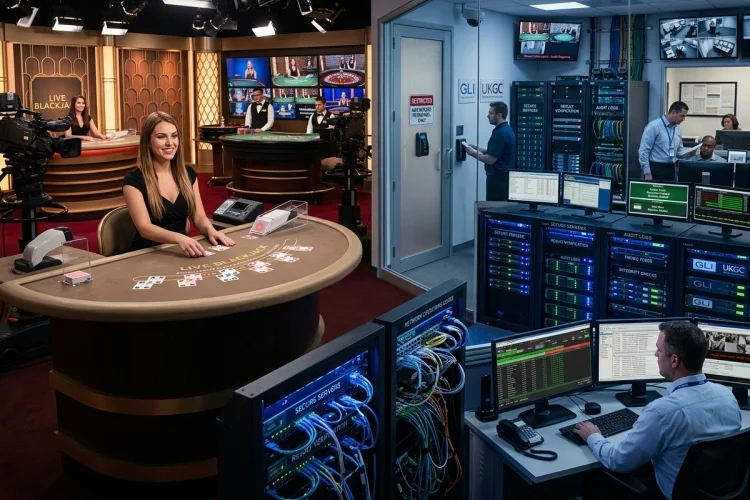
How Live Casino Streaming Works Safely Behind the Scenes
A professional live casino broadcast is designed to appear relaxed and entertaining. Behind the presenter, however, the operation follows security procedures closer to those of a regulated casino and financial technology platform than an ordinary entertainment stream.
Every accepted wager involves money, timing, game integrity, and personal account data. The operator must demonstrate which bets were received, when the wagering period ended, what physical outcome occurred, and how each balance was settled.
A video feed without reliable transaction records would not be sufficient. Understanding how live casino streaming works safely behind the scenes means looking beyond cameras and studio décor.
Important controls include restricted access, dealer training, surveillance, secure servers, result verification, audit logs, and formal procedures for interrupted or invalid rounds.
The UK Gambling Commission requires licensed live dealer operations under its authority to be fair and independently auditable.
GLI standards similarly describe continuous recording, secure equipment, equivalent player feeds, and systems that prevent early access to outcomes.
Studios Use Controlled Access
Live casino equipment is placed in a restricted environment rather than an ordinary public filming location. Access may be separated between presenters, floor supervisors, surveillance teams, technicians, and authorized management.
This reduces opportunities for interference with cards, wheels, shoes, servers, or communications equipment. Entry rules can also help investigators determine who was present when an incident occurred.
GLI-19 states that live game equipment, gaming servers, control servers, and communication systems should be installed in secure locations protected against unauthorized access, environmental hazards, and power failure.
Dealers Follow Documented Procedures
Game presenters do more than appear on camera. They must handle equipment according to defined rules and communicate each stage clearly.
Procedures cover opening bets, closing the wagering period, dealing cards, announcing results, and responding to mistakes. Supervisors may be required to approve corrections or voids.
The UK Gambling Commission’s guidance for live studios refers to trained croupiers, commercial-quality equipment, supervision, surveillance, and game logs. These measures make the operation independently reviewable rather than dependent on the dealer’s word alone.
Wagers Must Close Before the Outcome Is Known
One of the most important controls is preventing late betting. The platform must finalize wagers before anyone can access the result.
In roulette, bets close before the ball settles into a pocket. In card games, the system prevents new wagers after protected information becomes available.
GLI standards specifically require live systems to prevent access to the gaming outcome before the wager has been finalized. They also require the result to be recorded before it is posted to the platform.
This separation protects both the player and the operator from result-based transaction manipulation.
Surveillance Records the Entire Round
The video presented to players is not necessarily the only recording. A studio can maintain separate surveillance coverage designed for security and dispute review.
GLI-19 calls for continuous, unobstructed recordings that identify the sequence, date, and time of each game. The footage should be detailed enough to confirm whether procedures were followed and should be protected against interference or deletion.
If a player disputes a roulette result or dealer action, investigators can compare the surveillance video, game log, and account transaction.
Systems Keep Detailed Game Logs
Each round produces more than a visual result. The system can record the table, time, accepted wagers, result, settlement, manual interventions, and any error condition.
These logs help detect irregular patterns involving equipment, staff, particular locations, or unusual result frequencies. They also support accounting and customer-service investigations.
GLI standards require live gaming activity and results to be recorded through simulcast control servers. UK requirements additionally state that operations must be independently auditable.
Independent Testing Supports Compliance
A provider’s own quality checks are important, but regulated markets may also require external testing or auditing.
The UK Gambling Commission’s testing strategy explains that live dealer requirements apply to relevant licensed studios. An audit conducted for another jurisdiction may be accepted when it sufficiently covers the required provisions; otherwise, an additional audit may be necessary.
Independent review can examine studio controls, game procedures, technical records, and whether the operation meets applicable standards.
Security Extends Beyond the Studio
The platform also needs information-security controls for accounts, communications, transaction data, and critical systems. A secure physical table cannot protect users if the account platform is poorly managed.
The UK Gambling Commission bases its remote-gambling security requirements on relevant controls from ISO/IEC 27001:2022. These requirements apply to critical systems intended to prevent customers from being exposed to unnecessary security risks.
Operators may use access controls, monitoring, system backups, incident response procedures, and protected communications as part of this wider framework.
What Happens During a Disconnection?
A frozen video does not automatically cancel a valid wager. The settlement depends on whether the bet was accepted and whether the player could still influence the result.
UK guidance states that when an operator has received the wager and the customer can no longer influence the outcome, the result should normally stand. If an interruption occurs before an outcome is generated in a single-stage game, the deducted stake should generally be returned.
Operators should publish their disconnection rules. Players should also avoid repeatedly refreshing or submitting the same bet while uncertain whether the first instruction was accepted.
Responsible Design Still Matters
A secure and fairly audited stream does not remove gambling risk. Continuous tables can make it easy to move from one round to the next without noticing elapsed time.
UK technical standards require elapsed-time information for relevant casino sessions and allow operators to offer duration reminders.
Players should use these tools alongside deposit limits and session budgets. Technical fairness means the game operates according to its rules; it does not mean the player has a long-term advantage.
Safe live casino streaming depends on several layers of control. Restricted studios protect physical equipment, trained dealers follow defined procedures, servers close wagering before results are available, and surveillance systems preserve evidence of every round.
Transaction logs connect accepted bets with verified outcomes and account settlements. Independent audits and information-security requirements provide additional oversight, while interruption policies determine how valid or incomplete wagers are handled.
Before playing, verify that the operator is licensed, read its game and disconnection rules, and check that your wager appears as accepted. Use session reminders and financial limits, because a secure broadcast still involves real gambling risk.