
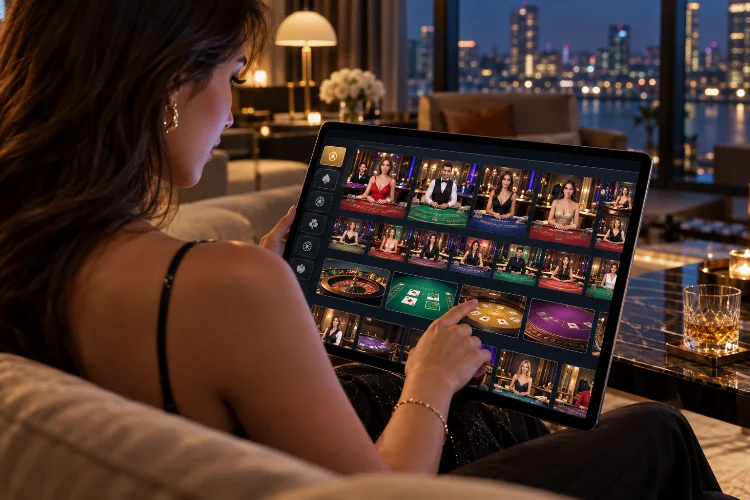
Opening a live casino lobby can feel a little overwhelming. Instead of a simple list of blackjack and roulette tables, modern platforms may display dozens of dealers, betting ranges, game variants, VIP rooms, language options, previews, and personalised recommendations.
Understanding Live Casino Lobby Features makes this screen much easier to navigate. The lobby is essentially the control centre between you and the live tables.
Learning what its labels, filters, previews, and categories actually mean can help you find suitable games more efficiently without assuming that prominently displayed tables offer better odds.
The Lobby Is More Than a List of Games
The simplest way to think about a live casino lobby is as a digital gaming floor.
Instead of physically walking past roulette, blackjack, baccarat, and poker tables, you browse them through tiles, categories, and filters.
Modern systems can go much further than a basic catalogue.
Evolution introduced its Smart Lobby in 2022 as part of an effort to make live games easier to discover, while earlier versions of its Live Lobby already allowed players to identify favourite tables and dealers and see live snapshots before entering.
That means the lobby is not simply decoration.
It helps organise a potentially huge selection of tables and gives players information before they join.
However, table position should not be confused with game quality. A game appearing first may simply be promoted, personalised, popular, or recently released.
Game Categories Help Narrow the Choices
One of the most basic lobby tools is categorisation.
Instead of scrolling through hundreds of tables, you may see sections such as Blackjack, Roulette, Baccarat, Poker, Game Shows, VIP Games, or Speed Games.
Evolution’s current live casino portfolio, for example, covers traditional games including roulette, blackjack, baccarat, poker, and craps alongside game-show formats and modified versions of established table games.
Categories become particularly useful when the same basic game has many variants.
A blackjack lobby might contain standard tables, Infinite Blackjack, Free Bet Blackjack, VIP versions, or tables using different languages.
The important thing is not to assume that every table within one category uses identical rules.
Two blackjack tables can look almost the same while having different side bets, seat structures, or specific gameplay conditions.
Search and Filters Save a Lot of Scrolling
Filters become increasingly valuable as a live casino catalogue grows.
Depending on the platform, you may be able to filter by game type, minimum stake, speed, language, VIP status, or other attributes.
Evolution’s Smart Lobby rollout has included search, favourites, recent games, game previews, and filters for characteristics such as low stakes, speed, and native-dealer tables.
A practical example is someone looking for blackjack with a relatively modest minimum stake.
Instead of opening ten tables individually, a betting-limit filter may reduce the available selection immediately.
Search functions can work in a similar way. Entering something like “roulette,” “Spanish,” or a particular game name may surface more relevent options without navigating several menus.
The feature is mostly about convenience, not strategy. A filtered table is not mathematically better simply because it matches your preferences.
Table Previews Show What Is Happening Before You Enter
A useful lobby feature is the live table preview.
Instead of entering a game blindly, some systems display a snapshot or video preview of the dealer and current table environment.
Evolution described this concept as early as 2016, when its updated Live Lobby allowed players to see live snapshots before choosing a table.
Modern preview cards can provide additional information such as the dealer, game description, and minimum or maximum wager range, depending on implementation.
This makes browsing feel closer to walking around a physical casino and checking a table before taking a seat.
Still, be careful about reading too much into recent results shown in a preview.
A sequence of roulette numbers or baccarat outcomes tells you what has already happened. It does not automatically show that one table is about to become more profitable.
Use previews to understand the environment, not predict the next result.
Minimum and Maximum Bet Labels Matter
One of the most practical pieces of information in a lobby is the betting range.
A table might show something like $1–$1,000, while a VIP table could operate at substantially higher levels.
Evolution notes that its live casino offering includes different tables and betting limits, ranging from smaller-stake options to VIP and Salon Privé environments intended for customers comfortable with higher minimums and maximums.
Check the minimum before entering.
A beautifully designed VIP table is not especially useful if its starting wager is far above your planned entertainment budget.
Likewise, table limits should not be interpreted as recommendations.
A maximum wager simply describes what the game accepts. It does not mean using that amount is sensible.
This distinction becomes particularly important when premium tables are placed prominently in the lobby.
Seat Availability Can Change the Experience
Some live casino games have limited seating.
Traditional live blackjack commonly uses a fixed number of player positions. Evolution’s standard format historically uses limited places, while Infinite Blackjack was specifically designed with unlimited seats.
A lobby may therefore show whether seats are available.
If a conventional blackjack table is full, you may need to wait, select another table, or use a scalable variant.
This feature matters less in games such as standard roulette, where many players can usually participate in the same round without occupying individual blackjack-style positions.
Understanding the difference prevents unnecessary frustration.
A “full” indicator does not mean the casino itself is at capacity. It normally refers to that particular game’s player-position structure.
Dealer and Language Information Can Improve Usability
Live casino is built around human interaction, so dealer information can matter more than it does in standard digital casino games.
Some lobbies identify the current dealer or clearly label native-language tables.
Evolution has long developed localised live offerings, while its game portfolio includes tables targeted at different markets and player groups.
For someone who prefers interacting in a particular language, this can make a substantial difference.
Dealer labels can also help players return to a familiar table, although dealer rotations mean the same person will not necessarily remain there indefinitely.
Do not confuse language or dealer preference with odds.
The dealer may change the atmosphere and communication quality, but legitimate game procedures and published rules still determine how the table operates.
Favourites and Recently Played Sections Reduce Friction
Once someone regularly uses a large live casino lobby, favourites become surprisingly useful.
Instead of repeating the same search every visit, favourite tools can store quick links to preferred games. Recently played sections work similarly by surfacing tables accessed before.
Evolution’s Smart Lobby implementation has included both favourites and recent-game discovery alongside personlised recommendations.
These are convenience features.
They do not indicate that your favourite roulette table has better payouts or that recently played games somehow remember your previous results.
It is also worth distinguishing personalisation from probability.
A recommendation engine may learn that you frequently browse baccarat. That explains why more baccarat appears in your lobby; it does not mean the software has identified a table where you are more likely to win.
Game Rules Should Still Be Checked Inside the Lobby or Game
A lobby can make discovery easier, but it should not replace reading the actual rules.
UK Gambling Commission standards for applicable regulated games require rules to be easily available before a customer commits to gamble. Relevant information about how winners are determined, payouts, and the likelihood of winning must also be accessible.
That matters when similar-looking variants appear next to each other.
A roulette variant might use additional multiplier mechanics. A blackjack game could have different side bets. A baccarat table may use a modified commission structure.
The lobby gets you to the table.
The rules tell you what you are actually playing.
Taking a few moments to check them is more useful than choosing solely from thumbnails or promotional labels.
Understanding Live Casino Lobby Features makes large live casino catalogues much easier to navigate. Categories, filters, previews, betting ranges, seat indicators, dealer information, and favourites all provide useful context before you join a table.
Use those tools to find games that suit your preferences and planned budget, but always check the actual rules as well. A convenient lobby helps you browse – it does not change the mathematics behind the game.